
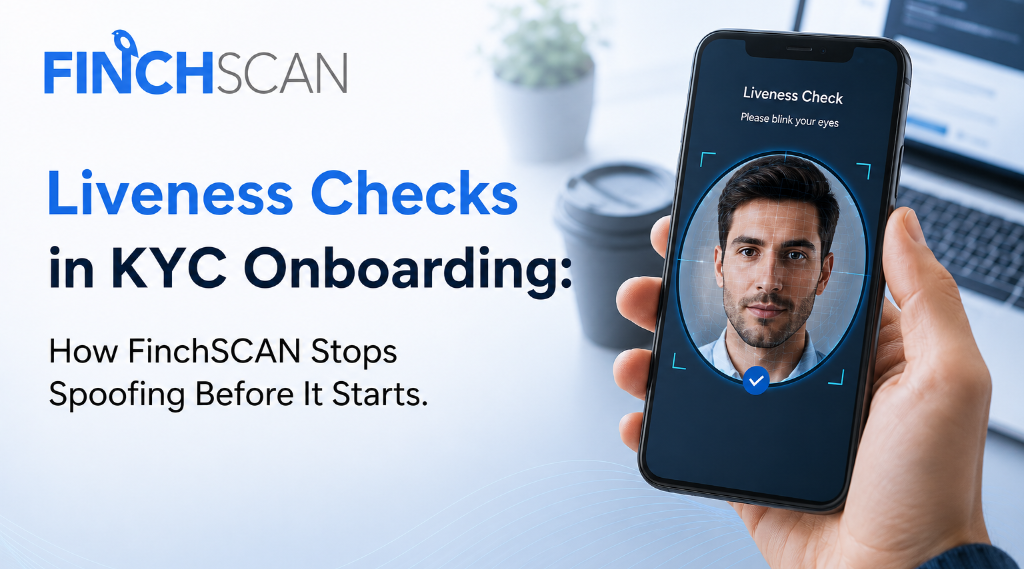
A secure onboarding journey begins with one simple question: is this person really who they claim to be, and are they actually present right now? Answering that question in real time without slowing down the customer is the job of a liveness check, and it has quickly become one of the most important layers in modern KYC (Know Your Customer) onboarding.
What Is a Liveness Check?
A liveness check is a biometric verification step that confirms a live, physically present human is completing the verification and not a photo, video, mask, or digitally generated deepfake. It sits alongside document verification and facial matching in a typical KYC flow, closing a gap that those steps alone cannot cover: proving the person on camera is real, present, and not a replayed or synthetic representation of someone else.
Without liveness detection, identity verification can be tricked by something as simple as holding up a printed photo or playing a video on a second screen. With it, organizations gain a much stronger signal that the identity being onboarded is genuine.
Why Liveness Checks Matter in Onboarding
Digital onboarding removes the in-person moment where a human agent could once eyeball a customer and a document side by side. That convenience is exactly what fraudsters try to exploit. Common spoofing techniques include:
- Print attacks — holding a photo of someone’s face up to the camera
- Replay attacks — playing a pre-recorded video of the victim
- Mask attacks — using 3D-printed or silicone masks
- Deepfake and synthetic media attacks — using AI-generated video to impersonate a real or fabricated identity
Each of these attack types targets the same weak point: a system that only checks whether a face matches a document photo, without confirming that the face belongs to a living person interacting with the camera in real time.
For regulated industries like banking, payments, crypto, insurance — this is not just a fraud problem. It is a compliance problem as well. KYC and AML frameworks increasingly expect organizations to demonstrate that their identity verification process is resistant to spoofing, not just that a check took place.
How FinchSCAN Liveness Checks Work
FinchSCAN Liveness Checks are built to detect spoofing attempts at the exact moment a user is onboarding, without adding friction to the experience. The check typically works by:
- Capturing real-time biometric signals from the user’s device camera during onboarding
- Analyzing micro-signals of “liveness” — such as natural movement, depth, texture, and response to prompts that are extremely difficult for a static image, video replay, or mask to replicate
- Cross-referencing the live capture against the submitted identity document to confirm the person onboarding is the same person the document belongs to
- Returning a real-time result, allowing legitimate customers to pass through instantly while flagging suspicious attempts for review
This can be done through active liveness (prompting the user to blink, turn their head, or follow an instruction) or passive liveness (analyzing a single capture or short video without requiring user action), depending on the balance an organization wants between friction and assurance.
The Balance: Security Without Sacrificing Experience
The strongest liveness check is worthless if legitimate customers abandon onboarding because it is slow or confusing. FinchSCAN is designed to run its liveness verification in seconds, as a natural part of the onboarding flow rather than a separate hurdle, so customers move from “I want to sign up” to “I am verified” with minimal delay, while spoofing attempts are caught and stopped before they ever reach account creation.
That combination of strong fraud detection plus a smooth customer journey — is what makes liveness checks a foundational layer of digital onboarding rather than an optional add-on.
Where Liveness Checks Fit in the KYC Onboarding Journey
A typical digital onboarding flow using FinchSCAN might look like this:
- Document capture — the user submits identification documents.
- Data extraction and validation — key details are pulled and validated against the document using OCR and MRZ technology
- Liveness check — the user completes a real-time biometric capture using live video and audio capture features.
- Face match — the live capture is compared against the document photo
- Risk decisioning — the verification result is updated into the KYC risk assessment
Liveness sits at the center of this flow because it protects the integrity of every step that comes after it. A face match is only meaningful if you know the face being matched belongs to a real, present person.
Why Liveness Checks are Important for Your Organization
Adding liveness checks to your onboarding process helps organizations:
- Reduce identity fraud by catching spoofing attempts before an account is ever created
- Strengthen KYC/AML compliance framework with a verifiable and auditable layer of identity assurance
- Protect customer trust by preventing account takeovers and synthetic identity fraud at the source
- Maintain a faster onboarding experience that does not punish genuine customers for fraud committed by others
The Bottom Line
As onboarding moves further into digital-only channels, liveness checks have gone from a nice-to-have to a baseline expectation in KYC. FinchSCAN’s approach to liveness detection gives organizations a real-time, spoof-resistant way to confirm that every identity behind a new account is real, protecting the business and the customer from the very first interaction.
Learn more about features in FinchSCAN’s KYC onboarding here: https://finchscan.com/kyc-onboarding